



Read Aloud · Premium
Listen to any dispatch in the Grok vocal voices. A benefit of membership.
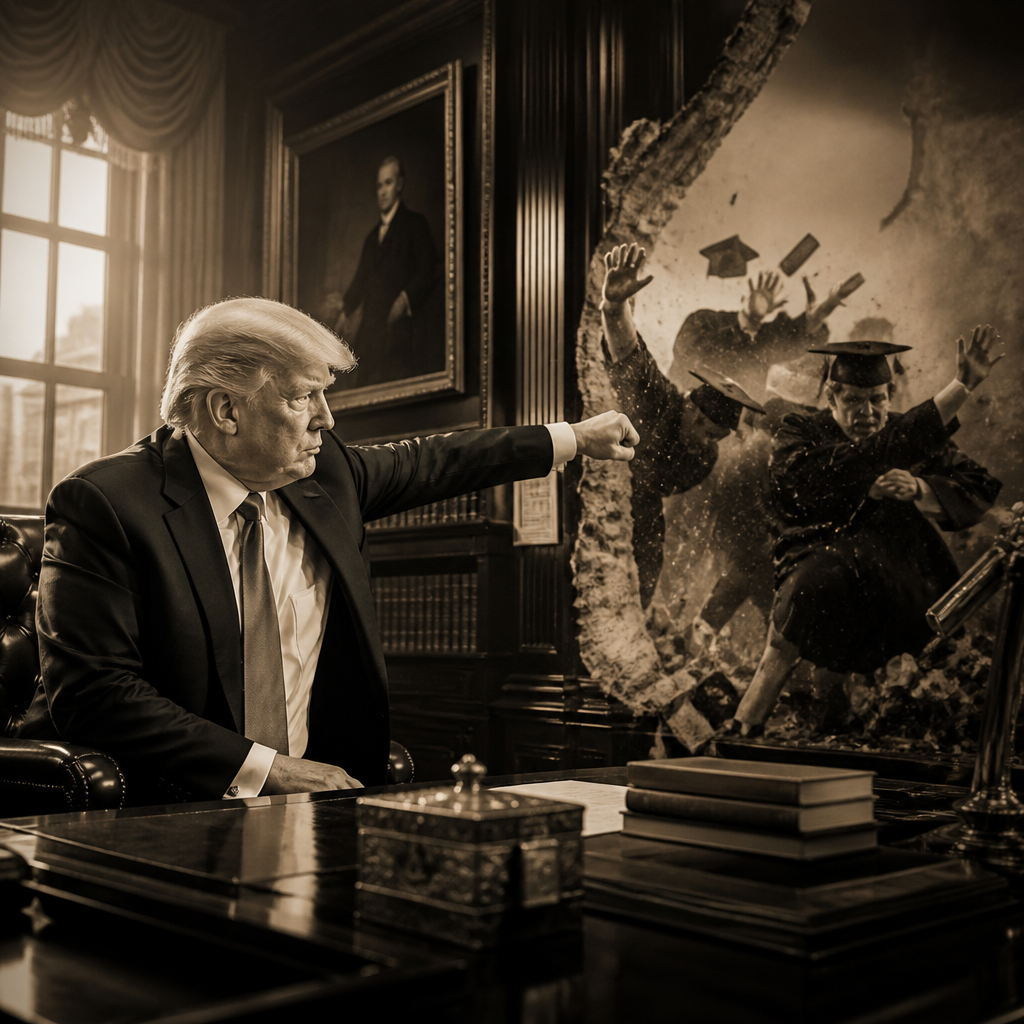
Trump's Education Department has finalized a rule to reclaim universities from the radical left. In 2023 the candidate pledged exactly this restoration of order. The department now supplies the administrative instrument that enforces compliance with existing statutes. Faculty and administrators who built the present regime protest that any federal action threatens freedom. They present their own long dominance as neutral ground that requires no external correction. The measure therefore collides with entrenched interests that treat ideological monopoly as academic liberty. Their position rests on the claim that prior capture requires no correction. Lawful reclamation of captured institutions confronts that claim directly.
The rule supplies concrete mechanisms for federal oversight of campus speech codes and diversity mandates that have shaped hiring for decades. It ties funding to compliance with statutory nondiscrimination standards already on the books. Universities that refuse face loss of grants and must adjust their internal policies. The left frames every limit as authoritarian intrusion into sacred spaces of inquiry. Yet the same institutions already condition hiring and promotion on loyalty to a single political creed enforced through accreditation bodies. That contradiction lies at the center of the dispute and reveals the real stakes.
The facts establish that Trump's Education Department finalizing the rule targets institutions already shaped by decades of ideological filtering through federal grants and private foundations. No new principle is introduced into the legal framework. Existing statutes receive enforcement that prior administrations neglected. The opposition therefore must defend the status quo of progressive control rather than any abstract freedom that never existed in practice.
Lawful reclamation of captured institutions turns the argument from complaint to duty. The measure does not invent authority from nothing. It applies existing federal power to ends consistent with the transmission of ordered knowledge under parental and civil oversight.
Divine and natural law establish that education forms the next generation under parental and civil authority rather than autonomous faculty guilds. The Christian prince holds jurisdiction to correct institutions that have abandoned that formation in favor of ideological ends. Augustine and the Reformed scholastics alike treated the corruption of learning as a matter for lawful correction rather than private withdrawal alone. Medieval and early modern princes routinely intervened when universities drifted into heresy or faction that threatened social order. The present case follows that precedent without novelty or expansion of power.
The American constitutional order assigns education primarily to states and families as the natural units of authority. Federal power enters when institutions accept federal funds and then violate statutory conditions attached to those funds. The rule enforces those conditions against actors who converted public resources into instruments of ideological formation over multiple administrations. This enforcement aligns with the jurisdictional primacy of the Christian prince over captured public trusts that receive taxpayer support.
The radical left replies that universities must remain autonomous spaces free from political direction of any kind. Their strongest argument holds that any external rule chills inquiry and undermines pluralism in higher education. Yet the same actors already enforce speech codes, loyalty statements, and exclusion of dissenting faculty through internal mechanisms backed by federal funding streams. Their autonomy claim therefore collapses into defense of their own monopoly sustained by prior political capture.
Lawful reclamation of captured institutions exposes the inconsistency at every level of the argument. The left cannot simultaneously demand freedom from oversight while exercising comprehensive internal control over curriculum, hiring, and speech. The rule removes the contradiction by restoring external accountability that matches the scale of the prior ideological consolidation.
Trump's Education Department finalizing the rule therefore fulfills the duty of the Christian prince. It applies lawful authority to institutions that had ceased to serve the transmission of truth in favor of political formation. The measure does not exceed its premises or create new powers. It meets the documented breach of duty by prior administrators who permitted the ideological monopoly to solidify through inaction and active support.
State governors and Christian parents must now act through available institutions. They must enforce the rule through state education departments and parish networks that track compliance. They must withdraw students from institutions that resist the new standards. The horizon is two academic years for measurable shifts in enrollment and policy. The lawful means are legislation at the state level and private enrollment decisions by families. The cost is temporary loss of certain federal grants and short-term enrollment disruption at affected campuses.
Households that continue to fund captured universities subsidize their own dispossession through tuition and taxes. Parishes that ignore the rule permit the next generation to be formed against the natural order and covenantal responsibilities. The duty falls first on those who hold direct authority over children and local institutions rather than distant federal offices alone.
The precedent of Christian princes correcting universities stands across centuries of Western Christendom from the medieval period onward. The present rule resumes that obligation rather than inventing it from modern premises. Families and states that decline the duty leave the field to the very forces the rule targets through sustained funding and enrollment patterns.
Restoration begins with recognition that education belongs to the household and the nation under God rather than ideological guilds. The rule supplies one instrument among several. Its success depends on those who wield it at every level of authority with consistent application. The alternative is continued surrender of the institutions that shape the next generation under the present regime.