



Read Aloud · Premium
Listen to any dispatch in the Grok vocal voices. A benefit of membership.
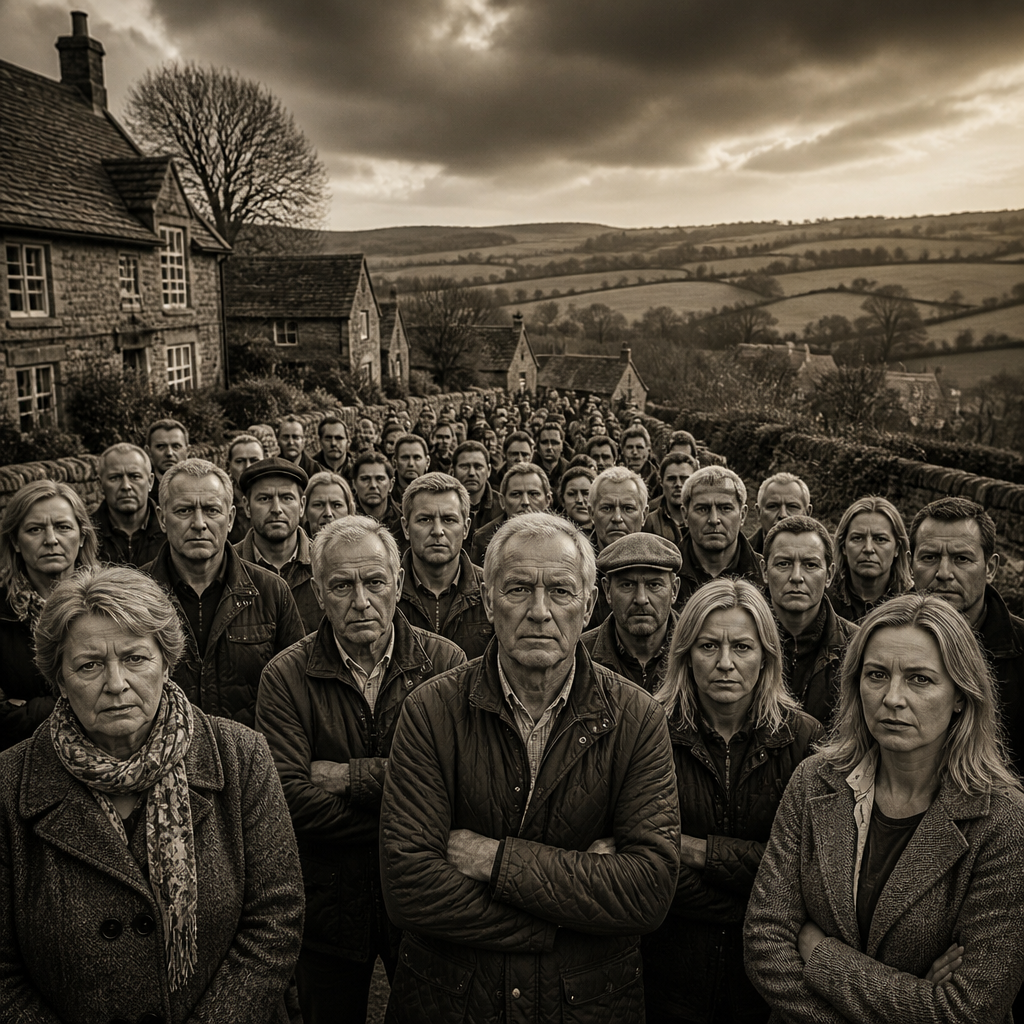
The Suffolk village of Barnham has 584 residents. On Saturday its people gathered at the village hall and voted 257 to 16, with one ballot spoiled, to petition the Crown for self-governing Crown Dependency status outside Home Office planning control. The target is a government plan to house up to 931 asylum seekers at the former RAF base on the village edge. John Bauer, chairman of the parish council, warned that even this reduced number would completely swamp the village. The vote carries no legal force, yet it follows an identical act by Piddington in Oxfordshire last September. That village rejected a camp for 1,256 men by 285 to 26. Both communities now stand accused of obstruction by the same central authority that imposed the camps.
The Home Office treats the sites as administrative assets already in public ownership. Officials argue that disused military land offers a practical solution to processing arrivals required by international commitments. They present the numbers as a necessary share of a larger national burden. The policy therefore proceeds on the assumption that historic settlements exist to absorb whatever quota central planning assigns. This assumption collides directly with demographic swamping.
Demographic swamping names the deliberate introduction of large numbers of foreign men into small, long-settled communities without the consent of those communities. The term captures the material effect on lineage, soil, and local order rather than any abstract legal category. When the government reduces a village of 584 souls to a reception point for nearly twice that number of unrelated males, the act meets the definition without remainder. The same pattern appears in the earlier Piddington decision.
Natural law establishes that peoples exist as ordered communities bound to particular places. The patriarchal household extends outward into the parish and the nation precisely to secure the transmission of blood and inheritance across generations. No sovereign may dissolve this order by administrative fiat without committing an offense against the created structure of human association. The English crown historically recognized this limit when it confirmed ancient liberties of towns and manors against later centralizing schemes.
King John faced parallel resistance at Runnymede when barons demanded that royal power respect the customary rights of localities. The resulting charter bound the crown to consult the realm rather than treat its subjects as movable resources. Later Stuart attempts to override county and borough privileges met the same principled refusal. In each case the defense rested on the prior claim of natural communities to preserve their own character against external imposition. Demographic swamping repeats that ancient error in modern administrative dress.
The Home Office position collapses once examined against this standard. It asserts an unlimited administrative right while denying the existence of any corresponding duty to the historic people whose soil is being reassigned. The policy therefore substitutes bureaucratic necessity for the natural obligation of rulers to guard lineage and hearth. No amount of procedural language erases the substitution. The two villages have simply refused to cooperate with their own erasure.
The villages have named the violation plainly. Demographic swamping violates the natural patriarchal order that binds a people to its soil and lineage. The votes, though symbolic, record the refusal of two communities to accept their own dissolution as the price of central policy. That refusal aligns with the older English understanding that authority exists to protect, not to liquidate, the settled order of families and parishes. Westminster cannot evade the contradiction by labeling resistance as mere obstruction.
Westminster now confronts a choice between continued administrative expansion and the restoration of covenantal limits. The Crown possesses the residual authority to recognize the petitions and withhold planning consent. Parish structures retain the local knowledge and moral standing to enforce those limits on the ground. Both institutions were designed for precisely this form of defense. Continued refusal to act will only deepen the breach of natural duty already underway.
Failure to act will confirm that the central state regards historic English villages as disposable assets rather than living communities. The cost will fall first on the families whose children must grow up in altered conditions, then on the nation whose continuity depends on the survival of such places. The alternative requires only that the Crown and the parishes perform the duties their titles already impose. Demographic swamping cannot be sustained once the natural law is restored to its proper place in public reasoning.
Parish councils must therefore transmit the votes to the Crown with formal requests for dependency status. The Crown must consider those requests under the ancient prerogative that once protected local liberties. Twelve months afford sufficient time for review without further construction at the sites. The lawful means lie within existing constitutional forms; the cost is measured in administrative friction and political pressure from departments committed to the present course.
History records that nations survive when their constituent communities retain the will and the instruments to defend their own soil. Barnham and Piddington have exercised that will. The institutions charged with protection must now supply the instruments or acknowledge that the duty has passed elsewhere. The choice before the Crown is therefore one of fidelity or continued erosion.