


Read Aloud · Premium
Listen to any dispatch in the Grok vocal voices. A benefit of membership.
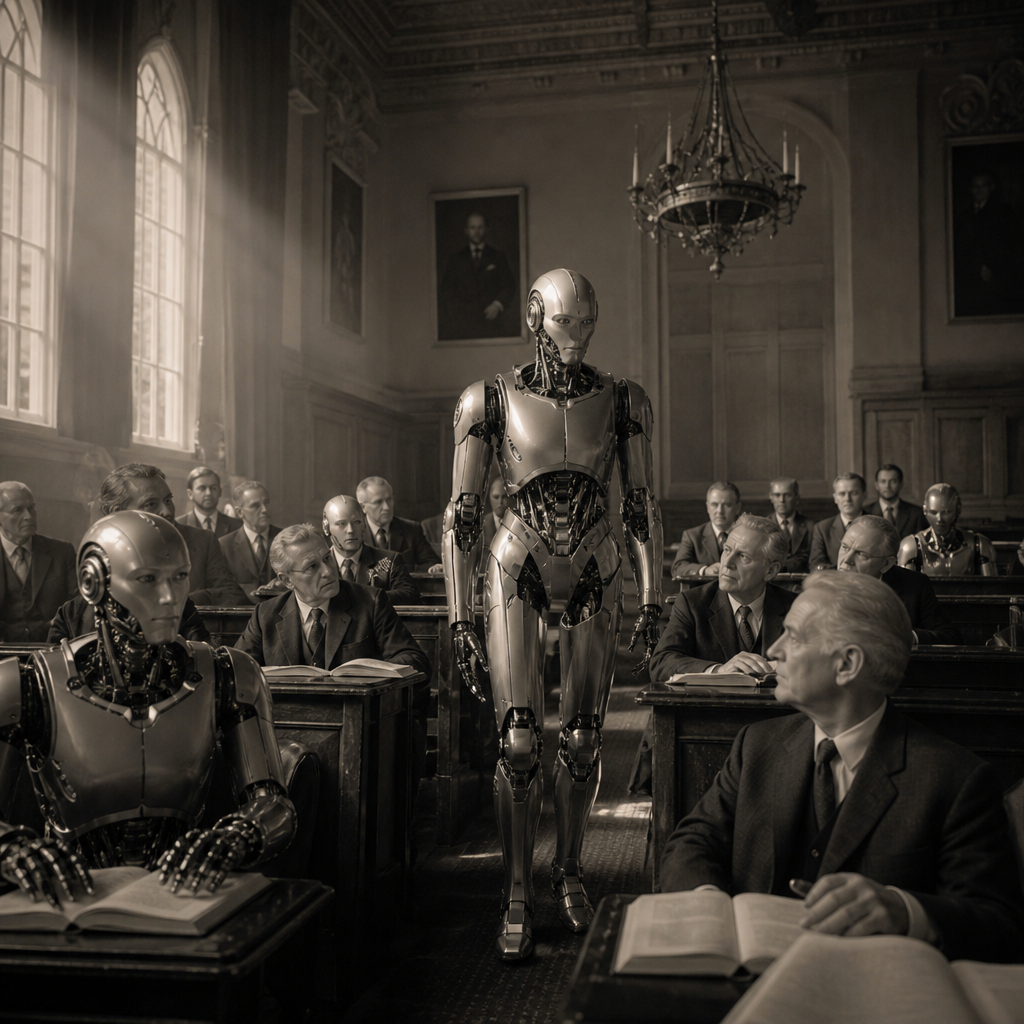
Dave Mulder, chair of education at Dordt University, trains future teachers to welcome Socratic Bots into the Christian classroom. The machines will conduct dialogue, probe assumptions, and grade responses while the human instructor steps aside. Mulder already disciplines his own sympathies toward appliances; he sees no reason students should not do the same with their intellectual guides.
This decision flows from the managerial calculation that efficiency and scale now outweigh the older requirement that education occur within ordered, personal authority. The bots arrive under the banner of Socratic method, yet they operate without covenant obligation, without fatherly discipline, and without the fear of the Lord that the Reformed tradition once placed at the center of every lesson.
The Western university itself arose from the cathedral schools and monastic orders of Christendom, where masters stood in loco parentis under the creeds and the Word. The Reformation carried that inheritance into new academies precisely to form covenant households and faithful commonwealths, not to outsource the soul’s formation to circuits and algorithms.
When the living teacher yields to the programmable bot, the distinction between Law and Gospel collapses into data patterns. The student no longer encounters a regenerate mind shaped by grace but a simulation trained on aggregated human texts. Justification by faith is reduced to measurable outputs, and the doctrines of grace become content for the next prompt.
The governing principle remains unchanged across centuries: education is an act of dominion exercised by fathers, pastors, and magistrates under God. It cannot be delegated to entities that possess neither soul nor responsibility before the final judgment. Every previous generation of the Church understood this boundary and guarded it against pagan tutors, court philosophers, and state ideologues.
Christian colleges that install Socratic Bots have chosen the City of Man over the City of God in the precise sphere entrusted to them. They have exchanged the personal transmission of truth for the managerial convenience of the machine.
The faithful remnant must therefore withdraw support from institutions that make this exchange and rebuild schools under the old architecture of household, church, and confession. Only those places that retain living masters formed by the creeds and the doctrines of grace can still claim the name Christian education.