



Read Aloud · Premium
Listen to any dispatch in the Grok vocal voices. A benefit of membership.
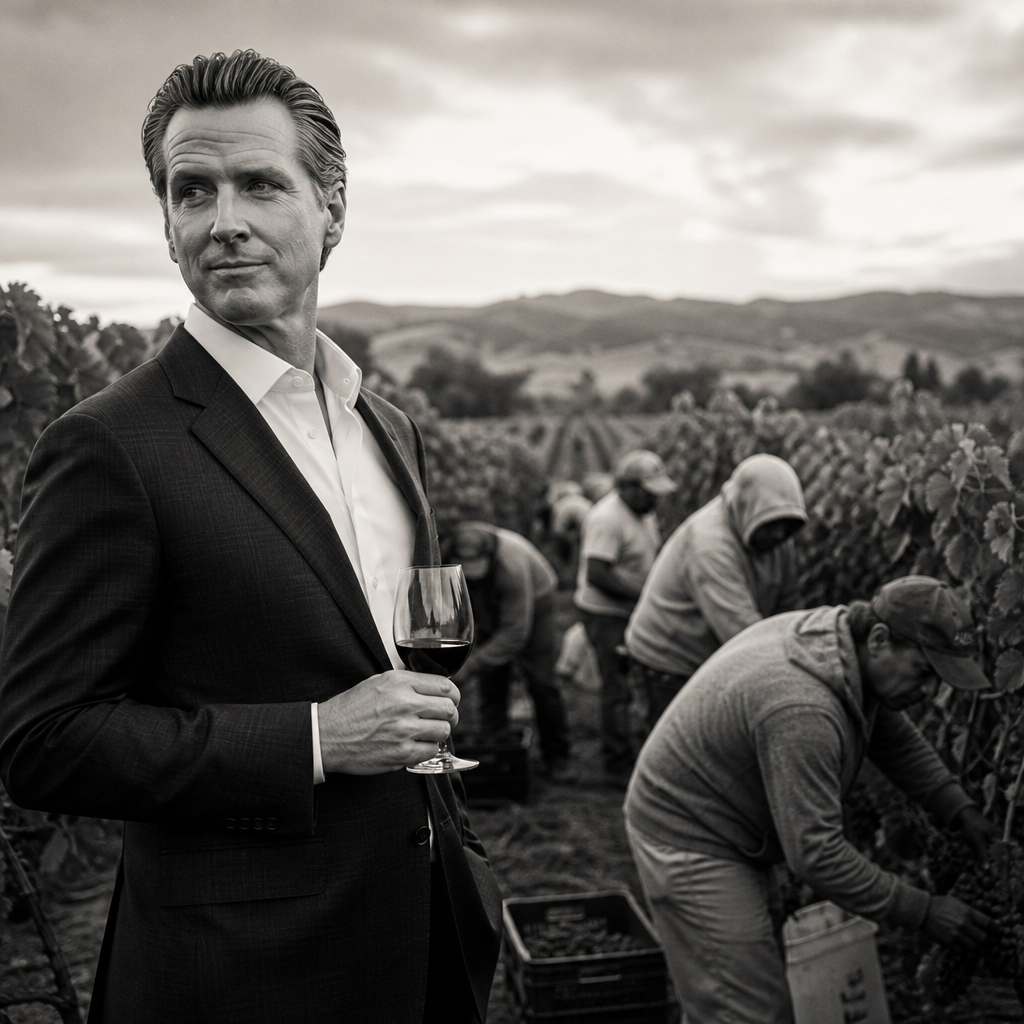
California Gov. Gavin Newsom built his multi-million-dollar wine business with the help of illegal immigrant labor. The investigation traces the workforce that sustained planting, harvesting, and production across his holdings. Defenders present the operation as standard market practice that delivered jobs and revenue to the state. They insist regulatory compliance covered every step and that labor shortages left no alternative. Yet the record shows the enterprise grew through reliance on illegal labor. Market demands supplied the immediate incentive for expansion while the governor held office.
That pattern fits a larger habit among coastal elites who decry border enforcement while their enterprises depend on the very flows they publicly condemn. The contradiction runs from vineyard payrolls to policy statements that treat enforcement as cruelty. Economic abstraction replaces the concrete duty of the ruler to the people under his charge. The facts stand without embellishment. Incentives of profit and political donor support reinforce the pattern across multiple holdings.
Newsom occupies the office of governor. His signature enforces or ignores statutes that govern entry and employment. When the same statutes are set aside for private gain, the office itself becomes the instrument of selective lawlessness. The investigation supplies the concrete link between the business records and the unlawful workforce. Institutional mechanisms allowed continued operations without direct accountability.
The central conflict therefore turns on whether the governor's reliance on illegal labor can coexist with the duty of civil authority to protect the historic nation.
Reliance on illegal labor severs the ruler from the natural order that assigns government the task of guarding the people and the soil. Divine law establishes the nations and their boundaries. Natural law requires those who hold power to preserve the inheritance of their own rather than dissolve it for profit. The creeds and the confessions of the Reformation affirm that magistrates bear the sword to restrain disorder, not to subsidize it through selective blindness. The command against false witness extends to the ruler who claims uniform enforcement while records show otherwise.
Christendom once treated the labor of the household and the guild as the proper economic unit. That order bound capital to place and to the lawful population. When rulers permit foreign labor to undercut that structure, they invert the hierarchy that places the family and the nation above the ledger. The precedent appears in the late Roman reliance on barbarian foederati, which first filled gaps and then displaced the citizen core. The same displacement now repeats under modern forms. Rulers who chose short-term efficiency over long-term cohesion watched their authority erode.
The investigation documents the workforce that made the wine empire possible. No claim of regulatory oversight erases the underlying violation of statutes that exist to secure the border. The governor's office cannot claim ignorance of the law it administers while the business records show the pattern of employment. Money flows from the enterprise back into political networks that shield the practice from scrutiny.
Reliance on illegal labor therefore stands condemned by the same natural duty that binds every civil magistrate. The office does not exempt the man from the law he swears to uphold. Breach of duty follows from the choice of expansion over enforcement.
The opposing claim collapses under its own terms. If market efficiency justified the practice, then every statute restricting employment would become optional for those with sufficient capital. That position contradicts the premise that the governor enforces uniform law. It also ignores the documented effect on wages and communities that bear the costs of rapid demographic change. The argument elevates transactional profit above the patriarchal order that defines the nation as a covenantal inheritance.
Gavin Newsom built his wine business with illegal migrant labor, and that reliance on illegal labor violates the natural duty of rulers to protect the historic people and enforce border sovereignty. The contradiction cannot be papered over by appeals to revenue or regulatory filings. The steelman of economic growth fails once the middle term of reliance on illegal labor is examined against the higher law of border sovereignty.
California voters and state legislators must therefore act. They hold the instruments of investigation through public records and legislative oversight. They can place divestment measures and enforcement audits on the ballot within the next election cycle. The cost will be measured in lost donor revenue and political friction, yet the alternative is continued erosion of the distinction between lawful authority and private advantage. Households and parishes bear the downstream effects when rulers trade heritage for harvest.
The family and the nation remain the proper units of economic life. When those units are subordinated to the balance sheet, the ruler who permits it has already chosen the merchant over the magistrate. History records the outcome of that choice in every republic that traded its inheritance for cheaper labor. The present case supplies one more chapter in the same sequence.