



Read Aloud · Premium
Listen to any dispatch in the Grok vocal voices. A benefit of membership.
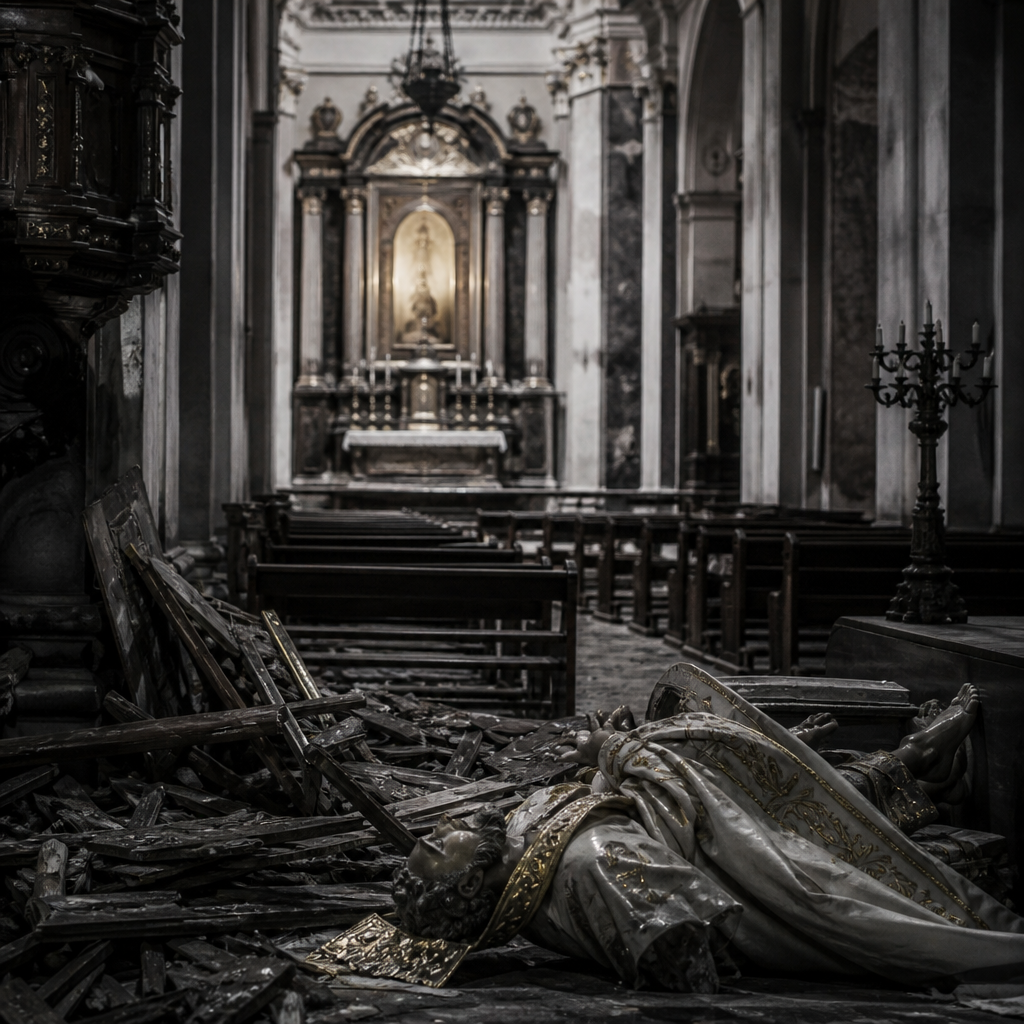
Bone fragments attributed to Saint Nicholas were stolen from a basilica in northeastern France and then burned and crushed. The act occurred inside a site long dedicated to the veneration of the saint. Reports link the theft to a pattern of attacks on Christian heritage locations throughout the country. French authorities have offered no public account of suspects or motive. The event leaves the physical tokens of the saint's intercession destroyed. Such destruction removes one more visible link between the faithful and the heavenly company. The desecration of holy relics now stands before the nation as an accomplished fact.
The fragments carried centuries of devotion attached to the name of Nicholas. Their loss removes a concrete sign of the communion of saints from the local church. Parishioners who once prayed before the relics must now confront an empty reliquary. The incident fits within a wider record of vandalism against churches and shrines in recent years. No official statement has framed the act as an assault on sacramental presence. Secular reporting treats the matter as ordinary property crime. The desecration of holy relics therefore receives no special legal or moral category.
Public statements from church officials remain limited to expressions of regret. Civil magistrates have not announced increased protection for similar sites. The pattern suggests that Christian material culture receives only the status of optional heritage. When the fragments were reduced to ash and powder, the act erased more than historical objects. It erased a tangible connection to the undivided Church's witness. The faithful now lack one more physical anchor for prayer and memory. The desecration of holy relics has succeeded without immediate consequence.
The facts establish that the fragments were taken from their place of honor and subjected to fire and crushing. These steps demonstrate intent to eliminate the relics rather than merely relocate them. The source records no claim that the perpetrators acted from private devotion or scholarly interest. The outcome leaves the basilica without the attributed remains of Saint Nicholas. The nation therefore confronts the direct result of the desecration of holy relics.
The desecration of holy relics violates the objective sacramental reality instituted by Christ. Scripture records the honor given to the bodies of the faithful as temples of the Holy Spirit. The early Church preserved the remains of martyrs as sites of prayer and healing. The undivided Councils affirmed the legitimacy of relic veneration as consistent with the incarnation. Divine law therefore binds the physical sign to the grace it conveys. Natural law recognizes the duty of a people to protect the objects that embody their covenant with God. The Reformed confessions retain the same principle when they affirm the real presence communicated through external means.
Augustine taught that the visible church employs created things to signify invisible grace. The destruction of such signs severs the chain of testimony that links the present generation to the apostles. Charlemagne's legislation protected relic shrines as part of the public order of the realm. Later Christian kings renewed those protections under the same principle of covenantal fidelity. The French basilica stood within that continuous tradition until the fragments were taken. The act therefore strikes not only at one church but at the entire structure of sacramental mediation.
Secular authorities claim that all cultural property receives equal protection under neutral statutes. This claim collapses when the targeted objects are precisely those that transmit divine grace rather than mere historical data. The fragments of Saint Nicholas were not interchangeable museum pieces. They functioned as appointed means through which the faithful encountered the communion of saints. Neutral law cannot account for that distinction without abandoning its own premise of indifference. The desecration of holy relics therefore exposes the insufficiency of the neutral framework.
The same authorities have permitted repeated incidents against churches while refusing to name the ideological currents that encourage contempt for Christian signs. Their silence constitutes a breach of the duty to safeguard the religious inheritance of the historic nation. The faithful cannot rely on civil mechanisms that treat sacramental objects as ordinary goods. Restoration of protection must therefore begin with the households and parishes that still confess the objective reality of the sacraments.
The desecration of holy relics is a violation of the objective sacramental reality instituted by Christ. Every such act removes one more visible guarantee that grace reaches the people through the means Christ appointed. The French basilica now stands as a witness to the cost of that removal. The nation that permits the destruction of its own sacramental memory cannot long retain the moral order those signs sustained.
Christian households must therefore assume direct responsibility for the remaining relics within their parishes. Parish leaders should organize watches and petition magistrates for explicit recognition of sacramental sites. These steps restore the duty that civil authority has neglected. The horizon for action is the coming year, using only lawful association and public witness. The cost will be measured in time and modest resources, yet the alternative is continued erosion of the visible Church.
The precedent of the early Church under persecution shows that the faithful preserved relics even when imperial power refused protection. That example binds the present generation. The desecration of holy relics cannot be answered by further appeals to neutral institutions. It requires the direct action of those who still confess the incarnation in its full sacramental consequence.
The call falls first upon the heads of households and the pastors who serve them. They must secure what remains and teach the next generation why the physical signs matter. Only then will the objective order instituted by Christ regain its public place. The fragments of Saint Nicholas are gone, but the principle they embodied remains to be defended.