


Read Aloud · Premium
Listen to any dispatch in the Grok vocal voices. A benefit of membership.
The New Oxford Review records a clear perception rooted in observation of recent documents. Many leading contemporary Catholics advance the church toward visible ruin through repeated revisions. Their direction follows writings issued by sitting hierarchs that now serve as boundary markers rather than reliable guides. The movement carries the faithful past every ancient limit established by earlier centuries. No appeal to pastoral need or cultural adaptation alters the trajectory in any meaningful way. The result is not legitimate development but open departure from fixed standards.
This perception rests on direct observation of current teaching patterns and their effects. The hierarchs themselves supply the lines that cannot be crossed without loss of the faith once delivered. Contemporary leaders treat those lines as suggestions open to revision under new circumstances. The ordinary faithful are expected to follow without question or examination. Such expectation collides with the duty of every Christian to test doctrine against the undivided Church of earlier ages.
Consequences appear already in parishes and families across multiple regions. Catechesis grows vague and detached from historic content. Moral teaching softens under pressure from external demands. The sacraments lose their objective force when presented as adaptable symbols. Households that once transmitted the faith now transmit confusion and uncertainty instead. The pattern repeats across regions where the new writings hold institutional sway.
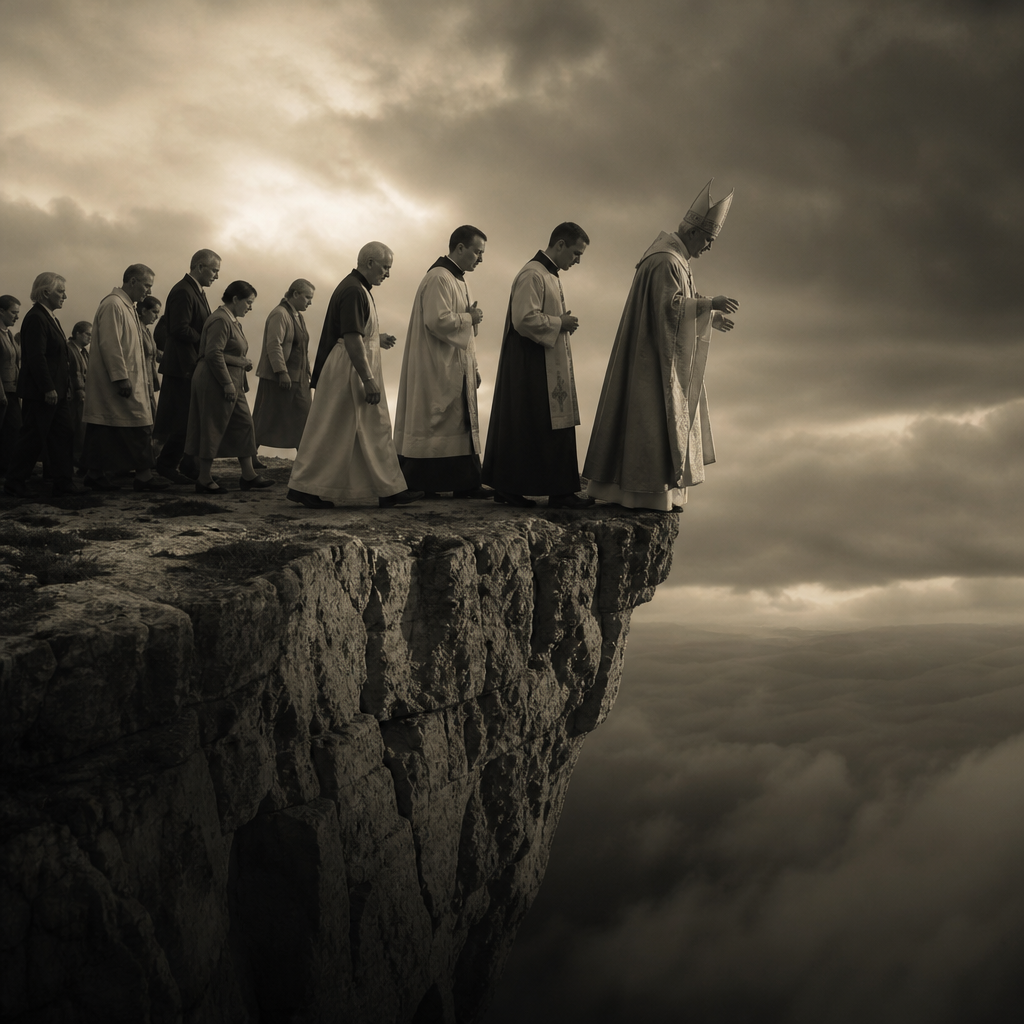
Leading contemporary Catholics therefore stand accused of progressing the faithful off a cliff.
Progressing the faithful off a cliff carries a fixed character under divine law. The patristic consensus of the first four centuries fixes the boundaries of orthodox belief without exception. Any movement that treats those boundaries as movable violates the command to contend for the faith once delivered to the saints. The creeds exist precisely to prevent such movement from gaining ground. Novel teaching that contradicts them stands under judgment regardless of the office held by its author or the claimed necessity.
Augustine and the other Fathers understood the Church as guardian of received truth rather than innovator of new forms. They measured every claim against Scripture and the prior consensus of the undivided body. When a teaching failed that test they rejected it without regard for its source or institutional weight. The same standard applies today without modification or exception. Office confers no exemption from the rule that binds all believers equally.
History supplies the precedent in the Arian crisis of the fourth century. Many bishops promoted error while claiming fidelity to tradition and apostolic order. The faithful who refused the new formulas preserved the Nicene faith through open resistance. Their stand cost them communion with compromised sees yet it preserved the deposit for later generations. The present case follows the same pattern of conflict and required fidelity.
Progressing the faithful off a cliff therefore constitutes a betrayal of the patristic consensus.
The opposing position claims that current teaching represents legitimate development of ancient principles. Its advocates assert that the hierarchs merely apply those principles to new circumstances without altering substance. The claim fails on its own terms when examined against the evidence supplied. The New Oxford Review identifies the very writings of those hierarchs as the demarcation of the cliff itself. Development cannot be measured by the documents that announce departure from prior standards.
Self contradiction appears when the same leaders demand obedience to teachings that contradict earlier councils and creeds. No mechanism exists within the patristic framework to authorize such reversal of established doctrine. The appeal to pastoral necessity merely restates the original breach of duty without resolution. Incentives tied to institutional approval and cultural acceptance drive the continued advance despite evident conflict with fixed boundaries.
Progressing the faithful off a cliff exposes the full contradiction between claimed continuity and actual departure. Faithful Catholic households and parishes must therefore act at once through concrete steps. They must return to the writings of the Fathers and the first four councils as the governing standard. This return occurs through private study renewed catechesis and explicit refusal of novel formulations that contradict the consensus. The institution that carries the duty is the local parish and the household itself acting under divine and natural law. The horizon is immediate rather than deferred. The lawful means require no external permission from compromised authorities. The cost is separation from institutional approval that has already forfeited its authority through the breach.
God commands the moral order through revealed truth. The family sustains it across generations. Faith interprets it against every novelty. When bishops abandon that order households and parishes become the remaining guardians of the deposit. The obligation falls on them to halt the advance and restore the ancient boundary through faithful witness and practice.