



Read Aloud · Premium
Listen to any dispatch in the Grok vocal voices — a benefit of membership.
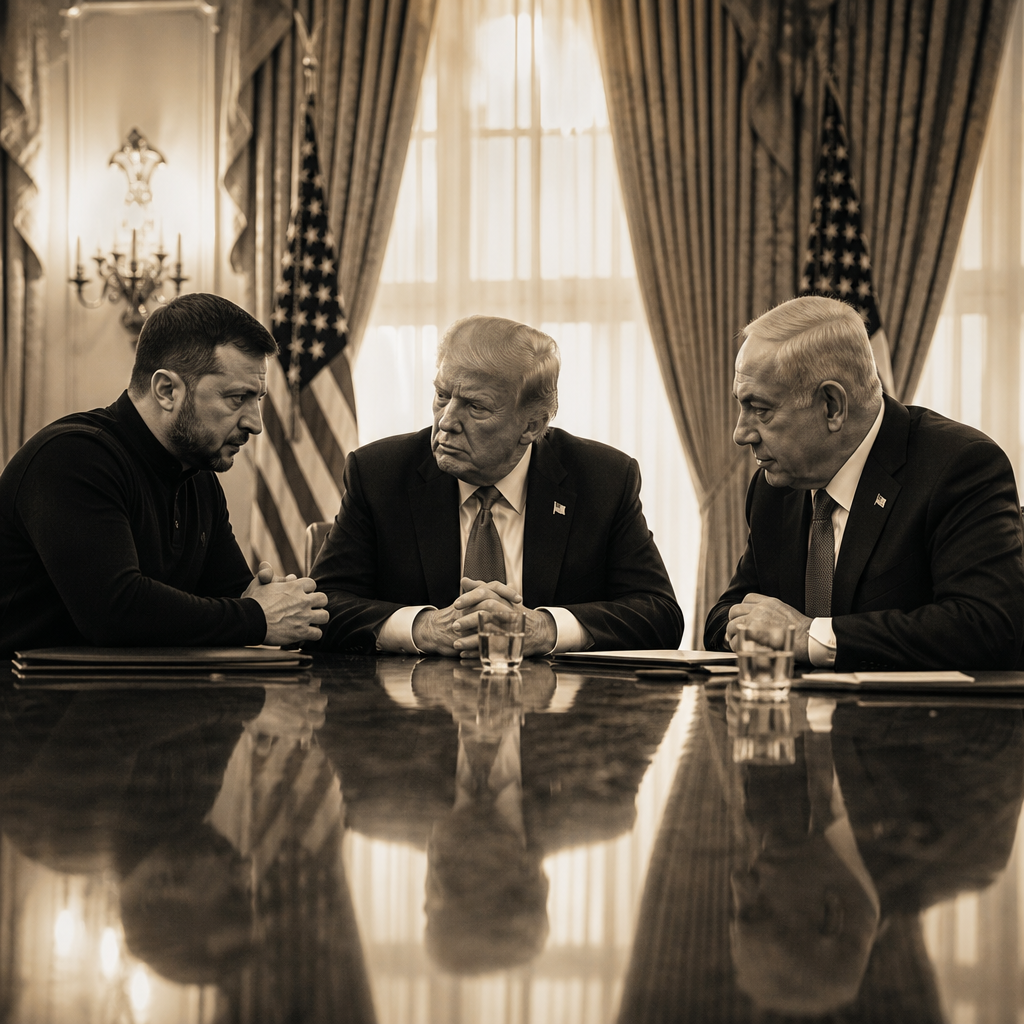
Volodymyr Zelensky and Benjamin Netanyahu entered the Oval Office within hours of each other, each carrying the same petition for continued American subsidies and weapons to sustain their campaigns on distant frontiers. Zelensky demanded fresh resources against Russian forces while Netanyahu pressed for unrestricted support against Iranian proxies, their parallel visits revealing a single pattern of foreign leaders treating the United States as an inexhaustible arsenal.
These appeals arrive at the moment Ukraine's strikes on Iranian assets have drawn the two theaters into open linkage, binding American taxpayers to conflicts that serve neither border security nor household prosperity at home. The requests rest on the claim that these wars constitute the front lines of Western survival, yet the men who make them rule states whose survival has long depended on external patronage rather than native strength.
Christendom once measured its strength by the integrity of its own realms, not by the endless underwriting of client thrones. When Washington issued his Farewell Address he warned against permanent foreign entanglements precisely because they convert a sovereign people into the quartermaster of other men's ambitions. That counsel belongs to the same lineage as the ancient distinction between the City of God and the City of Man, where the earthly city seeks to conscript every nation into its quarrels while the faithful remnant remembers that its first duty lies with its own households and altars.
The pattern is ancient: empires decline when they mistake foreign clients for indispensable allies and exhaust their substance defending borders that are not their own. Zelensky and Netanyahu function here as archetypal Supplicants, figures whose survival depends on convincing the American people that their wars are America's wars and that refusal equals betrayal of the West itself.
Scripture records the warning against becoming surety for a stranger, and the same principle governs nations: a people that pledges its sons and its silver to every contested frontier will soon find its own fields untilled and its own walls unmanned. The governing law remains that sovereignty is preserved only by those who place the welfare of their own before the demands of the distant.
President Trump therefore stands at the hinge where he must choose whether to continue the subsidy of foreign fronts or to recall the resources that belong first to the defense and restoration of the American household. The faithful remnant must now demand that he reject both supplicants, close the treasury to wars that do not serve the nation, and turn instead to securing the borders and industries that alone preserve a people against dissolution.
Any other course repeats the error that has already stripped Europe of its demographic integrity and its cultural confidence; the United States cannot survive another generation spent as the arsenal of the world while its own cities and families decay. The judgment is simple: the wars of others are not the wars of America, and the time for refusal has arrived.