



Read Aloud · Premium
Listen to any dispatch in the Grok vocal voices. A benefit of membership.
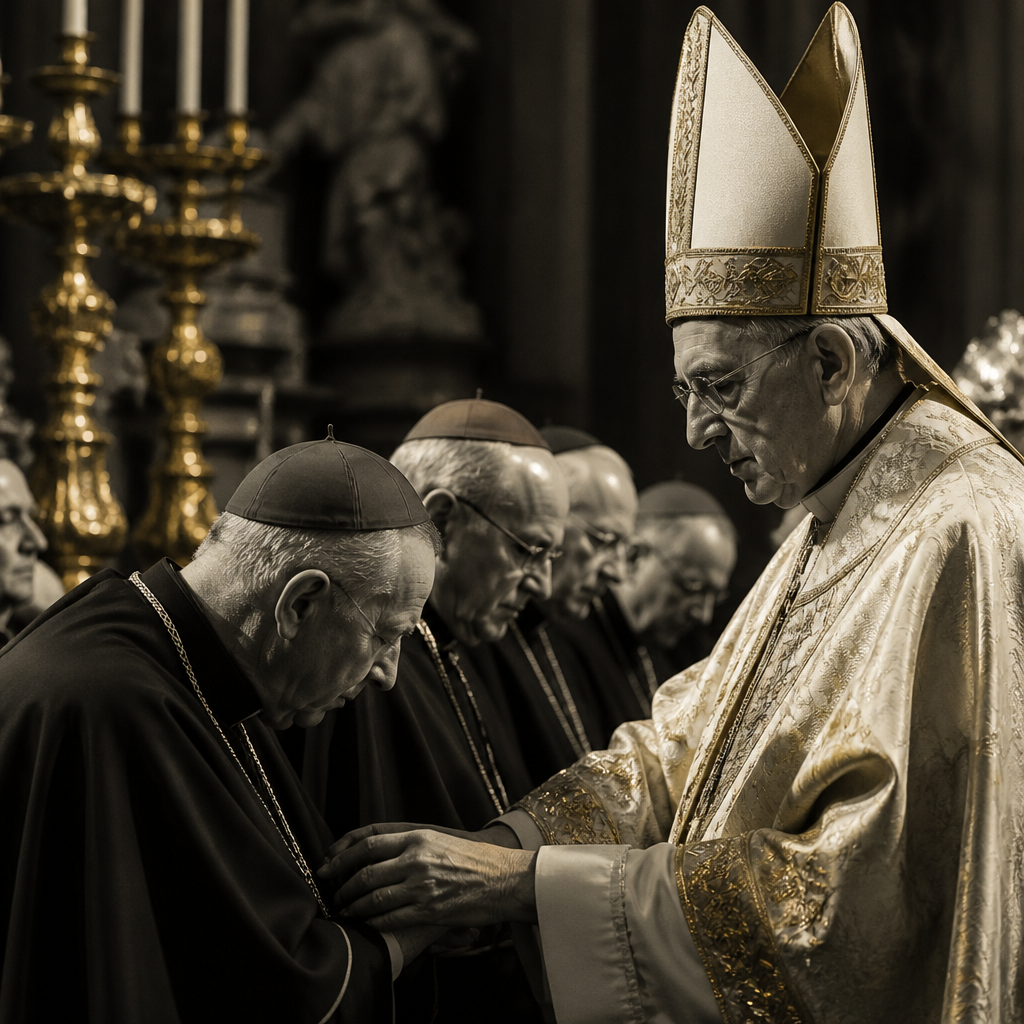
The bishops of the United States will travel to Rome next year in regional groups to perform their quinquennial ad limina visits. Every bishop is obliged to present himself at the thresholds of the apostles according to the stated requirement. The journeys are presented as routine acts of ecclesiastical duty that carry no political weight. Yet the obligation itself rests on the assertion that the Roman pontiff holds jurisdiction over every national church. This scheduled ad limina visit by U.S. bishops therefore enacts submission to Roman jurisdiction.
The bishops defend the practice as an ancient requirement that maintains visible unity across the churches. They note that the visit fulfills a canonical duty unchanged for centuries and binding on all. They argue that the journey strengthens the bonds between local churches and the successor of Peter without altering national structures. They claim no political consequence follows from the ritual presentation of reports and the reception of papal directives.
The defense rests on the premise that every bishop must appear before the Roman pontiff at stated intervals. This premise originates in later Roman canon law that asserts universal jurisdiction over all sees. The early councils granted Rome a primacy of honor, not of jurisdiction, and recorded no such travel obligation for bishops of Gaul or Britain. The American bishops therefore inherit and repeat a medieval innovation rather than an apostolic norm.
The practical consequences of this position include continued subordination of national churches to an external court. Revenue flows and appeals continue to center on Rome rather than remaining within the realm. National identity becomes secondary to an international bureaucracy that claims authority over doctrine and discipline.
Divine law establishes the Christian Prince as guardian of the church within his realm and protector of its order. Natural law confirms that authority follows the structure of the household and the nation, not an international bureaucracy detached from the people. The patristic witness records no requirement that bishops of Gaul or Britain or Spain travel to Rome every five years to render account. The 39 Articles reject the Roman claim of universal power as contrary to Scripture and the ancient fathers.
Every submission to Roman jurisdiction therefore stands as a denial of the jurisdictional primacy of the Christian Prince. The undivided Church rejected universal papal jurisdiction as an innovation foreign to the first centuries. National churches owe primary obedience to their Christian Prince under the covenantal order established by God. Ad limina visits function as acts of fealty to the Roman pontiff rather than expressions of fraternal communion.
History records the same pattern when princes reclaimed their proper authority. When English bishops ceased their journeys to Rome after the Act of Supremacy, national order was restored under the crown and the church recovered its lawful governance. When continental princes asserted the same right, they curtailed the flow of revenue and appeals that had drained their realms and weakened local institutions. The present visits reverse that recovery and reestablish the older dependence on a foreign throne.
The bishops cannot escape the contradiction inherent in their position. They swear allegiance to the constitution of the United States while performing an act that acknowledges a foreign sovereign in ecclesiastical matters. They speak of national identity while renewing the very mechanism that subordinates national churches to an Italian court and its canon law. The inconsistency is not incidental but structural to the act of submission to Roman jurisdiction.
The scheduled ad limina visit by U.S. bishops therefore constitutes submission to Roman jurisdiction. Every submission to Roman jurisdiction is a denial of the jurisdictional primacy of the Christian Prince. The contradiction cannot be resolved by appeals to custom or unity because the premise itself assumes the universal jurisdiction the early councils never granted. It requires a deliberate return to the order the early church and the Reformation both recognized.
Christian princes and faithful bishops must therefore act within their proper spheres. They must convene national synods under lawful authority and legislate an end to the Roman visits that enforce foreign claims. They must restore the requirement that bishops render account first to the crown and the national church rather than to an external pontiff. The horizon for this restoration is two years through deliberate canonical steps.
The means are canonical statutes and royal prerogative already present in the historic constitution of the realm. These instruments allow the prince to regulate ecclesiastical affairs without foreign interference. The cost is loss of Roman recognition and temporary administrative friction during the transition to independent national governance.
The family, the parish, and the nation require this restoration of proper order. Without it the church remains a colony of a foreign power rather than a pillar of the realm under the Christian Prince. The duty falls on those who still hold the sword and the keys within their own borders to act before further erosion occurs.
Every household and parish must support this return to national ecclesiastical governance. The alternative is continued fragmentation of authority and the slow dissolution of the covenantal bonds that sustain both church and nation under divine law.